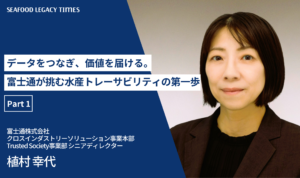
Connecting data, delivering value: Fujitsu's first step in fisheries traceability (Part 1)
Interview



Japan’s seafood industry faces rising environmental, social, and financial risks that are made difficult to address by a complex, often opaque supply chain, therefore making traceability an urgent first step. FAIRR released Seafood Index on 27th May 2026, which enables investors in assessing complex qualitative and quantitative company disclosures on 16 sustainability-related topics including traceability. The Coller-FAIRR Seafood Index includes 6 Japanese companies (Kyokuyo Co, Marubeni Corporation, Mitsubishi Corporation, Nichirei Corporation, Nissui Corporation, Umios Corporation), which have an average score of 20/100 compared to 30/100 average score for all 20 companies covered by the Index. Some progress is visible, including for example the mapping of risks related to wild-caught fish done by Umios and Nissui as part of their TNFD assessments.
Click here for the official website regarding the results.
https://www.fairr.org/tools/seafood-index/overview
Seafood industry sits at the heart of the global blue economy – a sector critical to both food security and economic growth. The seafood supply chain generates an estimated US $1.8 trillion annually, representing nearly 2% of global GDP. For Japan, one of the world’s leading seafood producers, consumers and markets, the industry underpins national culture, livelihoods, and nutrition. Yet, beneath this economic and cultural value lies a web of environmental, social, and financial risks that investors are increasingly aware of.
According to the Food and Agriculture Organization (FAO), 35.5% of global fish stocks are now overfished, while illegal, unreported, and unregulated (IUU) fishing contributes 26 million metric tonnes to the annual catch, or roughly 15% of the global total.
The human toll is equally stark. The Seafood Certification and Ratings Collaboration finds that 68% of countries assessed have documented cases of forced labour, child labour, or human trafficking in their seafood sectors, underscoring urgent governance and human rights concerns across the value chain. Fishing has a disproportionately high workplace fatality rate, with an estimated 32,000 casualties every year, a figure widely seen to be vastly underrepresenting reality.

FAIRR’s recent investor engagement with seven global seafood majors revealed that all companies acknowledge overfishing and marine habitat loss as potential threats to their supply chains. However, only three recognised traceability as a critical tool for addressing these risks – a concerning gap given that financial exposures often materialise when sustainability issues go unmanaged, through operational, regulatory, and reputational costs.
For Japan’s seafood industry, embracing traceability will be essential to safeguard market relevance, expand globally, attract responsible investment, and therefore unlock sustainable growth. The Coller-FAIRR Seafood Index measures performance on traceability as a foundational topic. The 6 Japanese companies scored 27/100 on average, the same as the full 20 company average.
Due to the importance of developing traceability to address risks related to social and nature risks in the supply chain, FAIRR will continue to engage with investors and Japanese companies on this topic in 2026 with Phase 3 of its Seafood Traceability engagement. FAIRR’s Phase 2 investor engagement with seven global seafood majors – was supported by 45 investors collectively managing US $9.6 trillion in assets, and backed by Planet Tracker, the World Benchmarking Alliance, UNEP FI’s Sustainable Blue Economy Finance Initiative, and the World Wildlife Fund (WWF) US – placed Japanese companies at the forefront of scrutiny. The dialogue included four domestic players: Marubeni, Umios (formerly Maruha Nichiro), Nissui, and Mitsubishi Corporation.
Progress across Japan’s seafood sector remains uneven. Last year, only Umios and Mitsubishi had robust traceability commitments, joining sector leaders Thai Union and CP Foods. Mitsubishi’s new Seafood Procurement Policy and updated Tuna Procurement Guidelines mark its most assertive public position on traceability to date – an important signal to investors seeking credible action. Yet Nissui and Marubeni have not provided evidence of traceability implementation plans, leaving significant gaps in supply chain visibility.
On the disclosure front, Japan’s seafood majors are taking promising steps aligned with the Taskforce on Nature-related Financial Disclosures (TNFD). All four companies(Marubeni,Umios, Nissui and Mitsubishi) apply TNFD’s assessment framework to identify priorities at the subsidiary, location, or species level – especially where operations overlap with biologically sensitive marine areas. This reflects a growing awareness that biodiversity risks carry real financial implications.
In sustainable sourcing, Umios and Nissui stand out for their transparency. Both conduct marine resource surveys to gauge the ecological sustainability of their stocks and have set public goals to achieve 100% sustainable seafood by 2030.
Amid these divergences, Japan’s seafood sector faces a pivotal moment. Strengthening traceability systems could transform not only operational resilience and investor confidence but also Japan’s leadership role in shaping a truly sustainable blue economy.
Beyond Japan, FAIRR’s broader engagement underscores a persistent implementation gap across the global seafood industry. While public commitments on sustainability and traceability are increasing, many risk stalling at the pledge stage. For example, the 20 companies in the Seafood Index scored 23/100 on average for Marine Raw Material Sustainability, reflecting low levels of deployment of supply chain initiatives for which traceability is a necessary starting point.
Even where implementation exists, progress often remains narrowly focused. For example, Thai Union’s SeaChange 2030 strategy applies traceability systems primarily to its tuna and shrimp lines, leaving other parts of its portfolio largely unaddressed. This selective approach limits the overall impact of corporate sustainability goals and obscures supply chain risks tied to other high-volume species.
Encouragingly, some companies are starting to align with higher standards. Mitsubishi Corporation and Thai Union now explicitly reference the Global Dialogue on Seafood Traceability (GDST) in their commitments – a step up from just one company doing so during FAIRR’s first phase of engagement.
Meanwhile, Umios has conducted a pilot scheme in collaboration with WWF Peru, focused on GDST-compliant electronic traceability. Using the TrazApp, which is compliant with the GDST, the Japanese company is testing its practices on the Peruvian American giant squid fishery. The app-based system enables fishers to log key data – such as location, vessel identification, catch method – directly onboard. The information is then shared across government agencies, research organisations, ports, markets, and fisheries.

Adoption of GDST-aligned systems represents a crucial bridge between voluntary initiatives and regulatory expectations, providing a harmonised framework for data sharing and interoperability across value chains.
Yet structural barriers continue to restrict traceability at scale. Over half of the companies (four of seven) cite reliance on paper-based records, fragmented data systems, and species mixing during processing as major obstacles.
The inherent complexity of seafood supply chains – spanning multiple jurisdictions, fishing vessels, processors, and distributors – compounds these challenges. Without investment in digitalisation and data integration, such as Umios’s pilot, even the most ambitious corporate commitments risk being undermined by incomplete or unverifiable product histories obscuring harmful practices.
For investors, this signals a pressing need for engagement beyond disclosure alone – focusing instead on evidence of implementation, end-to-end digital traceability systems, and integration of sustainability data into core business strategy.
For years, certifications have served as the dominant marker of sustainability in seafood markets – from Marine Stewardship Council (MSC) labels on tuna cans to Aquaculture Stewardship Council (ASC) badges on farmed shrimp. Certifications can be a useful mechanism to set standards and verify them, but frameworks focus on different issues and rarely tackle human rights issues for example.
The monitoring they enable is also limited. While certification can validate certain production practices, it only offers visibility one step up or down in the supply chain, raising the risk that information is lost along the way, either by mistake or intentionally. Robust traceability, by contrast, ensures transparency from catch to consumer – enabling companies to monitor various risks from IUU fishing to human risks, identify issues swiftly and respond effectively, and ultimately, to substantiate environmental claims.
FAIRR’s analysis shows that consumer demand in Asia for certified seafood remains limited. In some cases, certified products are sold without displaying eco-labels, reflecting weak market incentives and inconsistent recognition of certification value among consumers. This subdued demand underscores a structural challenge: to reach a truly global scale, certifications need to be complemented by systems that guarantee data integrity and traceability across complex supply networks needs to be foundational to how the industry works with fisherpeople and farmers.
Leading certification bodies are beginning to bridge that gap and deepen their collaboration. In January 2026, the ASC, MSC, Global Seafood Alliance and MarinTrust published an open letter asserting their support for the GDST and its 1.2 standard, driven by the urgent need for a global framework to advance standardised, digital, interoperable traceability systems. In their letter, the signatories recognise that the GDST framework helps certifications reduce administrative burdens and data duplication, while improving the accuracy and timeliness of data as well as the integrity of certified seafood products.
Together, key industry stakeholders are shaping a future in which certification and digital traceability work hand in hand, driving consistency, investor confidence, and genuine sustainability impact across the seafood industry.
As the seafood sector navigates mounting environmental, social, and financial pressures, one theme stands out: traceability underpins future resilience and competitive advantage. Robust traceability systems enable companies to uncover risks early, demonstrate transparency to regulators and investors, and prevent reputational harm before it becomes financially material. In an era defined by shifting market expectations and tightening disclosure frameworks, traceability represents both a risk mitigation tool and a driver of strategic value.
The critical next step is transforming ambition into action: implementing traceability across entire portfolios, setting time-bound milestones, and seeking independent verification that gives investors confidence in reported data. Without these measures, sustainability pledges risk remaining aspirational rather than operational.
1.For seafood companies
Japan’s leading seafood players can accelerate change by integrating traceability as a core component of corporate risk management across the value chain, including wholesalers and retailers. This means moving from commitments to concrete, time-bound implementation strategies; strengthening independent verification mechanisms; and adopting digital innovations and cross-sector best practices that enhance data reliability and transparency.
2.For investors
Investors have a pivotal role to play in catalysing action. By systematically requesting evidence of robust traceability systems, urging companies to adopt globally recognised standards, supporting cross-sector collaboration, and recognising the value of these actions, investors can drive accountability across the value chain. Participation in Phase 3 of FAIRR’s Seafood Traceability Engagement, now open for sign-on, offers a direct channel to influence corporate behaviour and shape the next frontier of sustainable seafood investment.
Ultimately, Japan’s seafood industry – long a cornerstone of the global blue economy – has both the capability and obligation to lead. Turning ambition into action will not only safeguard marine ecosystems and human rights but also secure the financial resilience and long-term competitiveness that define sustainable value creation.

share






















































Key terms and concepts to understand seafood sustainability.