
A Necessary Path for the Financial World: Making the Blue Economy a Commonplace Economy (Part 2)
Interview


Planet Tracker’s latest research reveals a transparency crisis in the global tuna industry that threatens both marine ecosystems and investor portfolios.
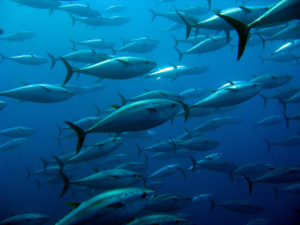
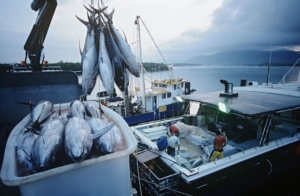
Despite commendable progress in recent years, unsustainable practices persist in the tuna industry, with several stocks still overfished, a long-term decrease in tuna stock biomass, and several tuna species still endangered. That impact goes beyond the tuna industry itself: multiple groups of marine species from marine mammals to turtles and seabirds to other fish species face adverse impacts from bycatch as well as the increasing use of fish aggregating devices (FADs).
Unfortunately, companies typically do not publish their exposure or contribution to these risks, which means that investors in or lenders to these companies cannot correctly estimate their own association to these sustainability risks. So Planet Tracker had to fill that gap, using a vessel-by-vessel estimate of tuna catch data to calculate company-specific catch volumes.
It is not just about sustainability though. Prior to our report, any investor keen to understand market share data or analyse volume growth for harvesters of tuna would have struggled. Indeed, amongst the thirty world’s largest tuna companies, despite collectively harvesting 46% of global tuna in our estimates, we found that only four companies publicly disclose catch data. This lack of transparency means external observers cannot compute simple metrics such as market share or volume growth, but also directly impacts due diligence. Without comprehensive catch data and supply chain transparency, investors cannot accurately assess the environmental and financial risks that are embedded in tuna-dependent portfolios.
The situation only becomes more alarming when examining these companies’ fishing practices. Planet Tracker found that 56% of the major tuna companies’ catch cannot be publicly traced to a given company, due to missing ownership data or satellite tracking. Many vessels deliberately disable Automatic Identification Systems (AIS) during operations, creating more than 5,000 monitoring gaps per year. Most of the largest tuna companies are possibly spending more time fishing with AIS switched off than with AIS on, as per our analysis.
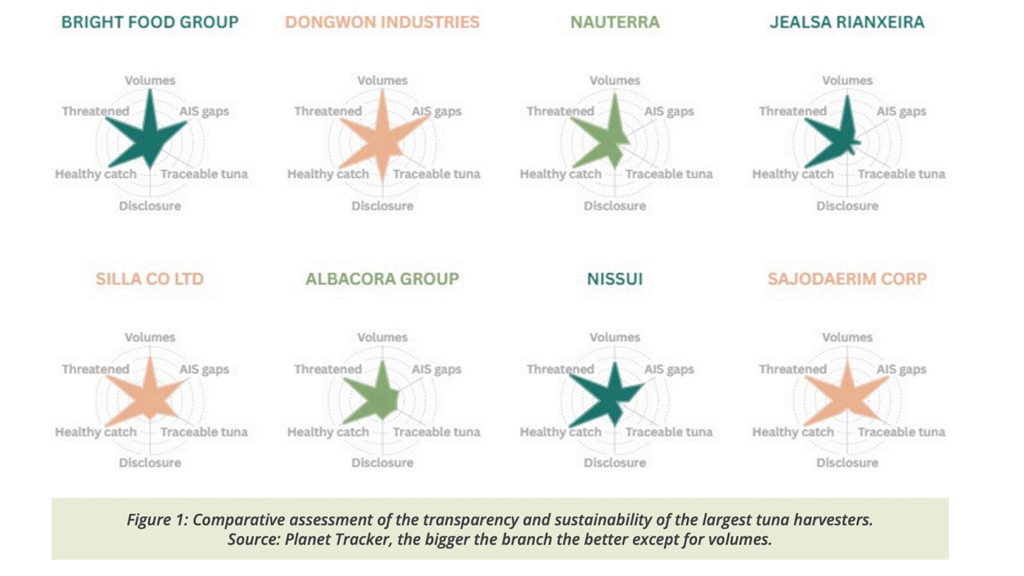
apanese companies play a prominent role in this industry. Looking at estimated tuna catch volumes of the 30 largest tuna fishing companies by headquarter, Japan occupies the fourth position after Spain, South Korea and China. Seafood giants Maruha Nichiro and Nissui are respectively number 7th and 16th in our ranking of tuna harvesters by volumes, with Fukuichi and Kyokuyo also in the top 30.
Yet the disconnect between corporate sustainability rhetoric and actual disclosure practices highlights a concerning contradiction in the industry.
All companies promote environmental responsibility through carefully worded sustainability narratives for their public reporting yet provide insufficient data.
For instance, 13% of global tuna catch comes from fisheries we call ‘at risk’, i.e. the eight tuna stocks that the International Seafood Sustainability Foundation (ISSF) does not rate as green for both abundance and fishing mortality (i.e. they are at risk of overfishing or becoming overfished).
Japanese companies feature in the top five harvesters of five of these eight stocks in our estimates, yet barely disclose their impact and dependency.
Maruha Nichiro
Maruha Nichiro is according to Planet Tracker among the five largest harvesters of four of the eight ‘at risk’ stocks that exist globally (bluefin tuna in the Atlantic, Pacific and Southern Ocean, as well as bigeye tuna in the Atlantic). This means that an estimated >60% of catch comes from such at risk stocks for Maruha Nichiro, based on Planet Tracker. Yet the company discloses very little: only its total tuna catch (47,000 tonnes) can be found online, but not a breakdown by species, stocks, or location. This needs to change, especially since the company is likely to be one of the key harvesters of threatened species globally, along with Albacora Group, Dongwon, Bolton Group and Sajodaerim.
Nissui and Kyokyuo
Nissui has taken a more transparent approach, publishing a list of the tuna species caught, as well as a list of endangered species impacted by their operations, highlighting critically endangered and endangered species found in some of their marine products and their responses to these findings. This is commendable. However, Nissui should also highlight the catch of species deemed as Vulnerable as per IUCN, since the definition of threatened species also includes this category.
Kyokuyo provides better disclosure than most, with both total tuna catch volumes as well as catch volumes by gear and location publicly available. It does not disclose its catch by species though. Out of the 30 largest tuna companies globally, it is also the company with the highest proportion of AIS gaps compared to its tracked fishing operations. That needs to change.
The ‘Tuna Turner’ report delivers an urgent message: the current industry opacity is unsustainable for both the oceans and the industry. Increasing transparency in the tuna industry is not just environmental necessity but an urgent economic imperative (that could even be financially profitable).
Planet Tracker is calling for companies to disclose four essential data metrics:
1.What they catch (which species)
2.Where they catch them
3.How they catch: (which gear)
4.How much they catch: (catch volumes in tonnes)
This, paired with greater AIS usage and transparent vessel ownership information, would create a better foundation for full chain traceable supply chains whilst also restoring investor confidence in the industry.
The tuna industry stands at a critical juncture. Continued secrecy in an industry dependent on a finite resource of tuna will create systemic risks that extends beyond individual companies. And for investors, the result is an ever-growing portfolio risk. In the long run, an absence of verified sustainability transparency increasingly represents competitive disadvantage for both companies and investors.
Japanese companies like Maruha Nichiro and Nissui must move on to substantive transparency. This begins with providing actual comprehensive disclosure of catch data which includes full transparency. The future of the fishing industry, and oceans overall health, are dependent on immediate action toward full transparency and verifiable sustainability practices.
François Mosnier
Planet Tracker Head of Oceans team
François brings 15 years of experience working across finance, nature conservation and sustainable food production. At Planet Tracker, he is in charge of driving change at corporates dependent on or impacting the ocean, using finance as a lever. The ocean team’s research focuses on fishing, aquaculture and deep sea mining, demonstrates the financial materiality of ecosystem health to investors, and advises them on what changes they need to ask companies to protect future returns. Prior to joining Planet Tracker, François was a financial analyst at Exane BNP Paribas and Capital Group, and a conservation finance specialist at Conservation Capital.
share






























































Key terms and concepts to understand seafood sustainability.