A Necessary Path for the Financial World: Making the Blue Economy a Commonplace Economy (Part 2)
Interview


[Series: Considering Japan's future fisheries resource management]
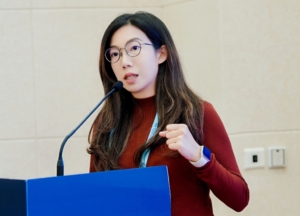
For the fifth installment, we received a contribution from Reon Watanabe of the Graduate School of Marine Science and Technology, Tokyo University of Marine Science and Technology. While researching the future of fisheries under environmental change in graduate school, Ms. Watanabe was a member of the first cohort of "THE BLUE CAMP," a student program organized by Chefs for the Blue that teaches about the sustainability of the ocean and food, where she visited sites where resource management is being implemented. Then, at the Fisheries Future Summit held in March 2026, she presented the results of the "Resource Management Case Studies Project," one of the projects that she and her fellow volunteers launched.
"Fisheries Future SummitThis initiative brings together volunteers from the fisheries industry across Japan to discuss and implement necessary reforms for the fisheries sector in a retreat format. Its distinctive feature is that it doesn't end with discussions; participants themselves launch projects and translate them into concrete actions. This column will introduce the "Resource Management Case Studies" created through the "Resource Management Case Studies Project" that originated from the summit.
Revised Fisheries LawWhile resource management based on Total Allowable Catch (TAC) has become the standard, fishermen are required to take voluntary resource management measures for fish species not covered by the TAC. In coastal fisheries, fish species not covered by the TAC account for approximately 6% of the catch volume and 8% of the production value, making it crucial to enhance the effectiveness of voluntary management. With the desire to support regions that want to further strengthen their resource management efforts, we have compiled a collection of resource management case studies, summarizing the content, systems, and processes of successful resource management initiatives.
The successful case studies gathered through the project shared a common pattern. First, a sense of crisis—such as "fish catches have decreased recently" or "we can't continue fishing at this rate"—was shared among local fishermen and stakeholders, and a small team was formed to lead the initiative. Then, with the help of external experts from fisheries research institutes, universities, and government agencies, small, easy-to-implement rules were created and put into practice. Finally, the effectiveness was verified based on records, and the rules were revised. This cycle was repeated with the aim of restoring resources.
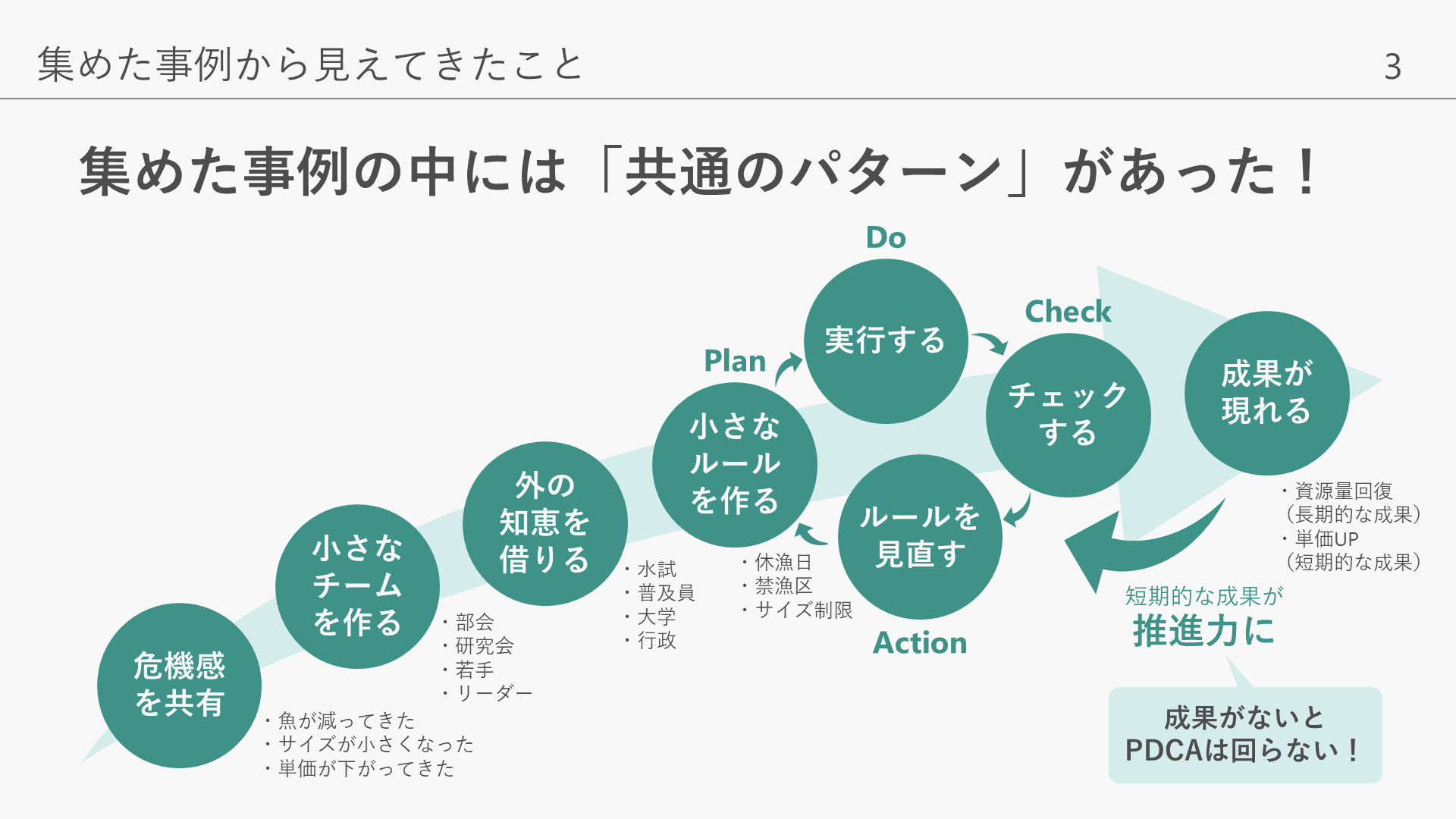 Diagram illustrating "common patterns" revealed from collected case studies (Resource Management Case Studies, page 3)
However, resource recovery takes time, and if the burden on fishermen becomes too great during that period, it will be difficult for them to continue their efforts. Therefore, it is important to create a situation where fishermen feel they can "continue their efforts a little longer" until the results of resource recovery become apparent. For example, if the number of operating days is reduced as part of resource management, operating costs such as fuel costs can be reduced. In addition, by reviewing sorting and shipping methods and working to improve quality in conjunction with resource management, it is possible to increase the unit price and compensate for the decrease in income. These business benefits alleviate the burden associated with resource management and give fishermen the strength to continue their efforts.
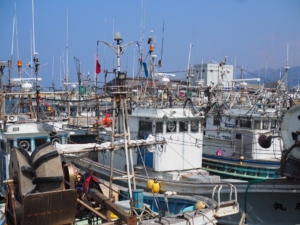
Now, let me introduce two initiatives featured in the case study collection. The first is the resource management initiative for splendid alfonsino carried out by the Chiba Prefecture Coastal Small Fishing Vessel Fisheries Cooperative Association. The cooperative has 16 fleets of fishing vessels from Onjuku Town, Katsuura City, and Kamogawa City, and is implementing resource management across regions by shortening operating hours, setting closed seasons, restricting fishing methods and bait, and releasing small fish back into the wild.
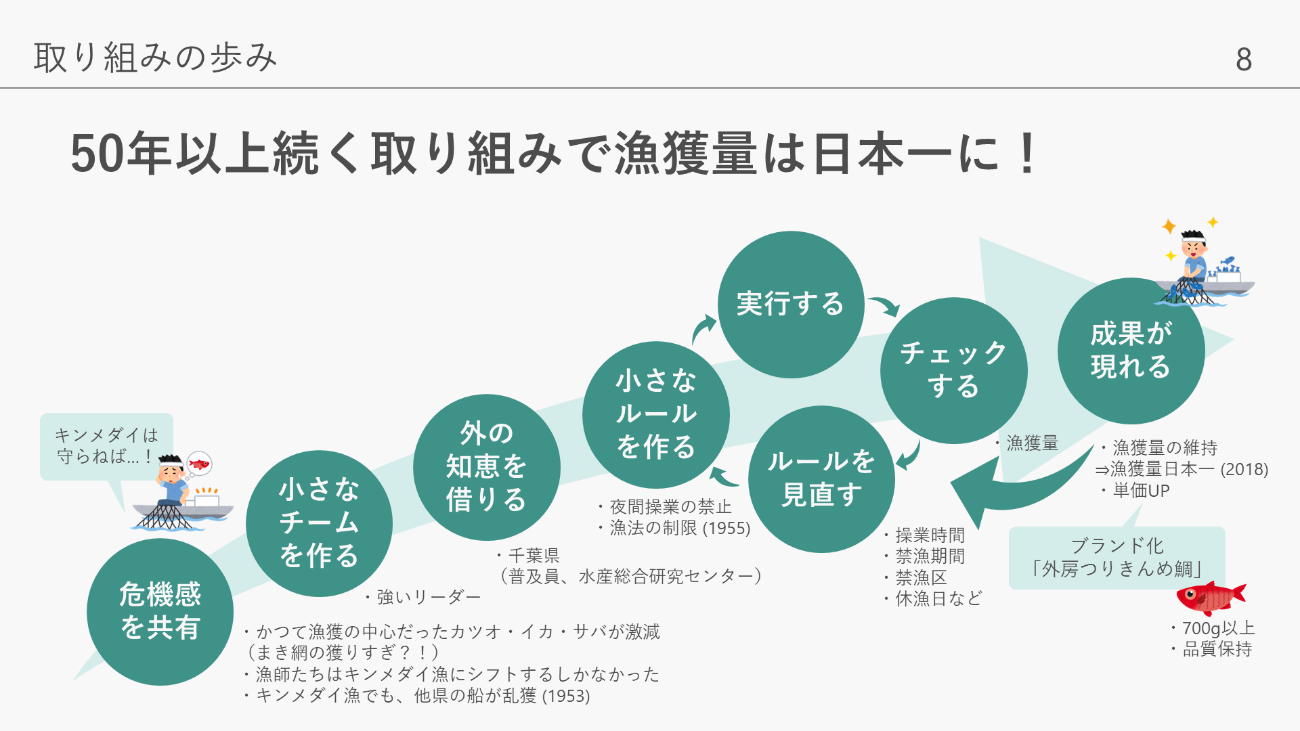 The progress of the Chiba Prefecture Coastal Small Fishing Vessel Fisheries Cooperative Association, organized according to the aforementioned "common patterns."
This initiative has been ongoing for over 50 years, and the rules are continuously reviewed to adapt to the state of the resources. For example, regarding fishing hours, discussions are held whenever catches decline, and over the 20 years from 1993 to 2013, the hours were shortened from 8 hours a day to 6.5 hours, 6 hours, 5 hours, and finally 4 hours.
These efforts are supported by thorough discussion. When deciding on rules, opinions are first gathered from each fleet, and then representatives from each fleet gather to discuss. At that time, decisions are not made by majority vote; if even one fleet objects, discussions continue until all fleets are satisfied. It is because the rules were decided upon after the crews themselves agreed with them that they continue to be followed.
The second example is the resource management efforts for spiny lobsters in the Wagu district of Shima City, Mie Prefecture. In the Wagu district, the Shrimp Net Alliance, composed of spiny lobster fishermen, has been at the forefront of implementing measures such as establishing no-fishing zones, restricting fishing gear, and reducing the number of nets since the 1960s. However, these were rules based on the fishermen's experience and lacked scientific basis.
The turning point came in the 1990s. The prefectural government and research institutions that conducted resource surveys proposed more effective management methods, such as raising the minimum age at which fishing could begin. Fishermen held numerous discussions and implemented the measures they agreed upon. For example, the minimum catch size was increased by 10 grams each year over three years. In this way, scientific knowledge was incorporated into the practices.
The acceptance of the scientists' proposals was due in large part to the ongoing communication. The scientists not only held study sessions but also built relationships with fishermen by helping with net handling and participating in local traditional events. In particular, the trust they built with young fishermen was instrumental in facilitating consensus building. The enthusiasm of the young fishermen spread to those around them, and even fishermen who were initially hesitant about introducing the new rules gradually began to understand. This illustrates that building relationships that bridge science and practical application is crucial for making the most of scientific knowledge.
Resource management is not simply about creating rules. It's crucial to consider how to create a system that stakeholders can agree on and continue, and how to incorporate scientific knowledge to enhance the effectiveness of those efforts. The case studies presented here offer numerous examples of how to achieve these goals. In recent years, with the marine environment undergoing significant changes, continuous review of rules in response to changing circumstances has become even more essential. We hope this collection of case studies will be helpful in supporting that process.
[Download Resource Management Case Studies]CLICK HERE]
References
Nishimura, Emi (2013) "A Study on the Collective Behavior of Fishermen and its Development: A Case Study of the Shrimp Net Fishing Group in Wagu District, Mie Prefecture," *Journal of Fisheries Economics*, Vol. 57, No. 1, pp. 107-122.
Text/Graduate School of Marine Science and Technology, Tokyo University of Marine Science and Technology
Reon Watanabe
<Past series>
[Series] Thinking about Japan's future fisheries resource management
Part 1: Reasons for the decline of Japan's fisheries resources and four necessary measures
2nd session: Discussion among ocean stakeholders
Part 3 - Connecting Food Culture to the Future
Part 4: Achieving overall optimization through centralized national management
share


































Key terms and concepts to understand seafood sustainability.